Smoothed Particle Hydrodynamics (SPH) is one of the meshfree Lagrangian CFD method proposed by Lucy and Gingold and Monaghan in 1977. SPH divide simulation domain into a set of particles and the properties of the particles are estimated by a kernel/smoothing functions.
For example, the property \( \Phi \) can be approximated as:
\[ \Phi_i = \displaystyle\sum_{j} m_j\frac{\Phi_j}{\rho_j} W_{ij}(r_i-r_j,h) \]
\[ \nabla\Phi_i = \displaystyle\sum_{j} m_j\frac{\Phi_j}{\rho_j}\nabla W_{ij}(r_i-r_j,h) \]
with, \( j\) is particle \( i’s\) neighboring particles, \( W_{ij}\) is the kernel/smoothing function.
SO, SPH can
Handle the solid-liquid and liquid-vapor interface intrinsically.
Track moving interface/boundary and free boundary in multiphase problems.
Facilitate the simulations with large deformation, discontinuities, and multiphase, and complex geometries.
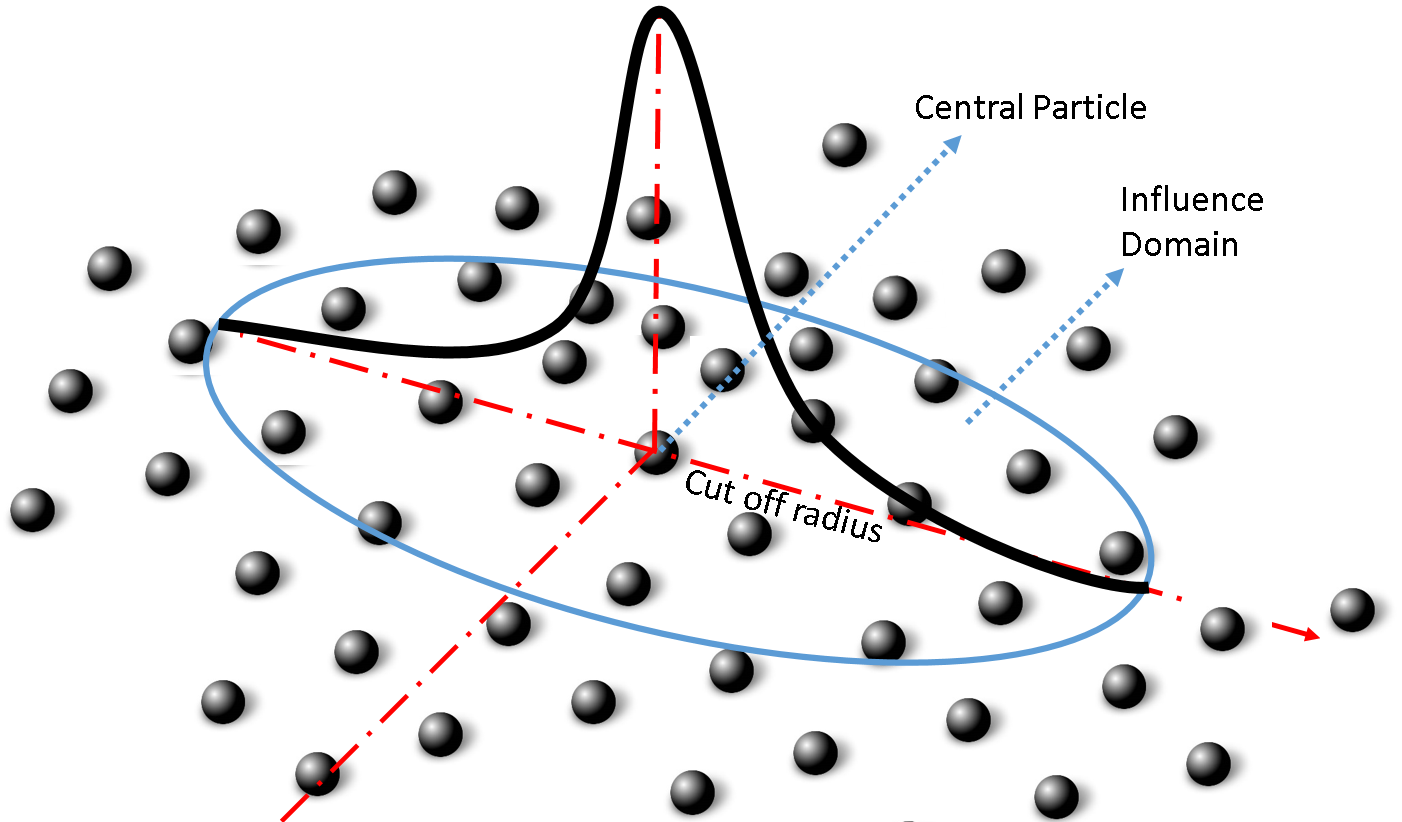
Smoothed Particle Hydrodynamics
Kernel estimation of the particles’ physical properties.

SPH Applications
SPH applications in: (a) Calculation of warp propagation in astrophysical accretion disc (Lodato, G. and D.J. Price) ; (b) Solid-fluid interaction involved dam-break simulation (source: Macklin, M. and M. Muller); (c) ship impact analysis (source: DualSPHysics)
2D Dam Break
This is a standard 2D Dam Break simulation using SPH.
Dam Gate Opening
2D Dam Gate Opening animation using SPH.